Assignment #3 Media Literacy
Post#1 Public PLN – Balancing PLN, Media Literacy, & Public Discourse

How do notable individuals use social media? People who are public figures, like entertainers, high-profile leaders, or others of significant influence, need to take extra care when using Social Media. Steph Curry, one of my favorite athletes, has such a huge presence that he was named the king of social media. He realized that his and many others’ online presence has declined mainly because they don’t have enough time to manage everything involved. Curry co- founded a startup company called Slyce, which lets the athletes publish all of their posts to multiple platforms at one time. They also have a tool that surveys thousands of fans’ questions that they would like to know more about so that the athlete can communicate more of what the fans would like to know. It would also be great if this company could serve as a curator/editor to ensure the athlete increases their brand and does not offend or marginalise any group of people.
• What are the benefits of being in the public eye and having a PLN? Being in the public eye, gives a person a platform to share what they believe and how they want to impact others. It also leads to finding others who have a common interest and deepen our understanding of content that we have in common.
• Building community with online tools provided by the employer can be limiting; what are the perceived restrictions and benefits? There are benefits and limitations to many different online tools that a place of work or school provides. Based on the readings below, tools have varied costs; some offer more or less control over what the user can modify, differences in features, web-based or on a local network, ease of use, and can host other online services.
• Delivering information in a connected society requires verifiable resources; how do you build a PLN to rely on? A reliable PLN, would need to provide references to where the source of the information they get comes from. The PLN would need to agree to back up all research by providing links and references to ensure what is being said can be backed up or supported.
• How do those who are veteran storytellers minimise risk in sharing misinformation? I believe experienced storytellers make sure that they know where the parts of the story they are telling come from. They would need to do their research from various sources before they go public with the story they are going to tell.
• What is media literacy? Digital Media is a way that a user can create forms of communication that are digital. For example, websites, podcasts, graphics, animations, video, and much more. It is best to select the best form of media for the topic and audience. It is critical to know if consent is given before using anyone else’s work.
• Why is it important? Media Literacy is important because the audience one can reach has the potential to be widespread or limited to those in a select group. Media can be curated in different ways with more or less complexity or detail.
• Why is it dismissed? Since media can be easily fabricated, it can also be easily faked. Once the public gets exposed to information that is made up, people can lose trust in a particular source of information.
• Why should you aim for varied views but factual consensus in your PLN? Having a variety of views in a PLN is important so that you can hear and learn from many perspectives. This leads to greater open-mindedness and trust within the network. Once the PLN shares factual information, then the dialogue between these different viewpoints can be based on truths, leading to sharing what we value most from our individual values.
Review of selected course readings and videos
Media Literacy from Ch.4 Digital Literacy Skills in the book 21st Century Skills: Learning for Life in Our Times.
The author explains that digital media gives students many ways to create engaging and effective forms of communication, such as videos, podcasts, websites, print graphics, animations, and more. However, creating this type of media requires several digital literacy skills. For example, students need to choose the right type of media for a specific topic. They must also gain permission before using other people’s work. In addition, they need to select the most appropriate digital tools for creating their media and decide on the best way to share and promote their final product.
Navigating Social Journalism: A Handbook for Media Literacy and Citizen Journalism by Martin Hirst Chapter 4. The Political Economy of Fake News – pp.78
The authors outline the use of fake news in social media from the 2016 US presidential elections to Brexit to The Cold War. There was a narrow definition made in 2017 that includes spreading false news by users rather than paying for this advertising or propaganda. Before this, fake news came in the form of newspaper stories of the sixteenth century that, just like the tabloids, sensationalized news topics that appealed to shoppers. Other ways of deceiving audiences were in the form of hoaxes, like H.G.Well’s “War of the Worlds.” Then, more recently, governments used deception to fake weapons and bombs, as done in the Iraq War. Taking advantage of a naive public has led to more stories fed to the public. Studies showed that from the mid 20’s to 2017, the amount of advertising of non-news content has tripled. Why then would news companies make this fake news? More profits come from news items that make people click, like, and share. Highly political propaganda and deception are often a motivation for news consumers to come back and watch and read similar false, made-up stories. Increasing evidence was shared that the fabricated stories are shared through bots that aggregate your preferences and feed you content that you find comfortable. The speed at which these stories spread, now appeals more to one’s feelings rather than questioning if it is factual. In addition, one’s bias in news reporting and blogging. The author shares that bias is our belief system (pg.89) in that part they explain that a reporter should be aware of their own view, beliefs, and biases. How do you view political sides, religious affiliations, worldviews, and your core beliefs? All of this, which makes up one’s bias, then leads us to judge what we trust is fake or real news. The more we distrust a certain news broadcasts leads us away from mainstream media and makes us trust more in our peer-to-peer validation of a story. The best quote that wraps up this said, “Audience psychology—wanting to feel connected by sharing—combined with high circulation speeds and algorithms that promote popular content, provides a fertile ground for the spread of what one group of researchers called the “digital catnip” of fake news (Carey 2017).” These writers suggest the following ways for us to deal with fake news when it is difficult to identify: Decide if a story is Fake vs Biased, increase our digital media literacy to be more objective, and find a way to put more money into fact-checking news using AI that does not impact the volume of sharing or the money earned. In the end, it comes down to rebuilding trust through transparency in mistakes made by news agencies, and revamping broken business models around commerce in advertising.
In the Public Eye-Social Media and Evening News with Sophie Lui, Global BC Anchor
Networking Then and Now
Sophie Lui explains that networking for a job looked very different in the past. People often built professional connections by making phone calls, going door-to-door, attending events, setting up meetings, and sharing videotapes of their work. Networking relied heavily on face-to-face interactions and first impressions. In addition, letters and phone calls were common ways to stay in touch with professional contacts.
Today, networking is much more connected through social media. Sophie describes a sense of “sisterhood” among broadcasters, where professionals can support one another online. It is now easy to comment on colleagues’ work, offer encouragement, and strengthen professional relationships quickly. Social media platforms like Twitter have also made it possible for people to share more about their experiences and the challenges they face in their careers.
Experiences with Twitter
Sophie discusses the challenges of using Twitter. She has spent a lot of time on the platform and has received both positive and negative comments. While she tries to ignore most criticism, she admits that negative comments can affect her depending on the day.
Rather than blocking people, Sophie often chooses to mute them. She feels this avoids giving them the satisfaction of being blocked while still allowing them to express their opinions. She values keeping communication channels open whenever possible.
Over time, she has become more cautious about responding on Twitter and now takes more time to think before posting a message.
Instagram vs. Twitter
Sophie also talks about her experience with Instagram. She has a verified personal account and describes Instagram as a happier and more positive space. On this platform, she feels comfortable sharing aspects of her personal life, including moments with her partner.
She views Twitter differently. While Instagram gives followers a glimpse into her everyday life, Twitter allows people to understand her opinions, interests, and intellectual side. As she explains, Instagram may show what she had for dinner, while Twitter reveals more about what makes her think and what issues she cares about.
Despite their differences, Sophie seems to believe that both platforms have value. They help people discover others with similar interests, build connections, and expand professional and personal networks.
Sophie concludes by saying that maintaining a social media presence is important. She hopes to continue developing her website and becoming more active online while learning how to stay relevant and engaging to the public. Ultimately, she believes that participating in online spaces and connecting with a broader intellectual community can lead to greater learning and personal growth.
• The risks and benefits of engaging with a public audience in a media space: Engaging in public discourse in a media space exposes your perspective, beliefs, biases, and professional/ private life. Any errors that you make or misunderstandings might need to be addressed or clarified. This exposure to the world has great benefit, as you can build up capital or a presence or a platform by which to share those values and beliefs you that matter most to you and are for the greater good of others.
• Consider what the risks for a public figure or person in a position of trust (educator, lawyer, government official) may be? People in these public-facing positions of trust risk being judged by those who have differing perspectives, biases, and beliefs. This can lead to their reputations being damaged and possibly losing that position, role or title.
• How to best address negative replies and critiques reflective of your personal values and employer social media policy? Some people can’t be bothered to address the negativity and critiques of others, as this can lead to unhealthy discourse. Often, getting a person to talk out their differences face-to-face is best, yet in an online setting, this would take more time and trust. When an employer’s social media policy is used to support the employee, hopefully it can state clearly that any negativity towards the employee is not acceptable if voiced in any public forums.
• Open dialogues about media literacy and factual information can create conflict; why does this happen? When people share facts that impact the lives of others online, this can lead to people sharing how those facts have impacted them positively or negatively. Since we all have different background experiences to bring to a conversation, we therefore bring our own biases, beliefs, and values that impact these conversations.
• What is the benefit of having a PLN that values media literacy? Having a PLN that values media literacy is beneficial so that the members in the group can collaborate in ways that build everyone’s collective understanding of the differences that others can share and learn from.
PLN & Education
Community communications go beyond blogs and social media shares; how does a PLN help and hinder the development of thoughts and ideas in education discourse? A PLN in the educational setting can help bring the level of learning higher for all who are passionate about better thinking about how to improve a particular learning experience.
• How do educators create discourse? Educators might bring questions regarding a new or emerging way of teaching or software program to improve the learning of their students. The sharing of thoughts, strategies or approaches can be done through blogs or other open forums so that other educators can also engage in further questioning and understanding.
• What is the role of social media in education? Social media has a significant role in education. The outward-facing online community can view what is happening inside the school as positive messaging to further promote the school’s mission and vision. Family members who want to get further involved in educational experiences can watch, read, and listen to most of what happens within a school.
• What are some problems with social media communications in education settings? Students or adults in a school can make mistakes by not following the school’s policies and acceptable practices. Some of the many problems can lead to a negative perception or image of the institution or the people who work or study their. Safeguarding everyone, especially those who are the most vulnerable, the students, must be of the highest priority to protect.
Themes of a PLN in a professional capacity.
• Which social media platforms are beneficial in education? Websites tend to be widely used and published in many places online. In addition, Twitter, Instagram, or Facebook can meet the greater community in a more timely manner, giving current or urgent news when needed.
• When working with the vulnerable sector, how does social media fit into professionalism and regulations? Working with the vulnerable sector requires people to be extra sensitive to consent, perception, and review before pushing out any data or media that can be taken out of context. No organisation should publish any information that might bring shame or misuse to harm others’ future. Therefore, a diverse team of professionals needs to collaborate to make plans to protect those who are vulnerable. With the help of lawyers, digital media experts, and others in the community, plans and reviews should be done regularly to ensure that the organisation is keeping up with the constant evolution of social media and how it might impact the constants.
Last review of selected course readings and videos
Education in a Connected Culture Dyer, Harry – Course YouTube Channel
In a world that is now infused with online social platforms, youth today learn online norms and values, and this helps them be better at communicating effectively. Harry Dyer, a researcher/speaker looks into identity, how we behave differently in these different spaces and in our actions and interactions. He states that in today’s social media are unfortunately used mainly with Facebook and Twitter alone (4:49). He says that there is a more porous gap between offline and online identity(6:48). For example, young people today refer to a video on YouTube, connect to it, and recreate it. Where teachers and adults in the past tried to find ways to plug holes in the wall between the digital divide and real identity, now we need to look at how gaining new relevant skill online can strengthen their identity offline and vise versa. We need to broaden our understanding through the use of online sites to learn about problems we had in the past. We need to use social media and new technologies to better understand. This use of emerging technologies leads one to be better able to communicate about one’s self distinctively.
Developing Personal Learning Networks for Open and Social Learning / Alec Couros- Part 2, Chapter 6
This chapter from Emerging Technologies in Distance Education focuses on educators who are interested in exploring the learning potential of Personal Learning Networks (PLNs). Alec Couros, a professor at the University of Regina, designed a course that was open, transparent, and networked through the development of a PLN. The chapter explores three main areas: the theoretical foundations of the course, the course experience and technologies used, and key discoveries and strategies for future implementation.
Theoretical Foundations
The chapter begins by discussing the open movement, which promotes the use of free and open-source software. This approach encourages collaboration, sharing, and openness in both classroom learning and professional practice (p. 111).
To design this particular course, Couros drew from several learning theories:
Social Cognitive Theory
Social Cognitive Theory considers behavioral, cognitive, and environmental factors that influence learning. In simple terms, people often learn by observing the actions of others and then modeling those behaviors themselves. Another important concept is self-efficacy, or an individual’s belief in their ability to succeed, which supports student-centered learning.
Social Constructivism
Social Constructivism emphasizes that knowledge is developed through social interactions. Learning becomes more meaningful when individuals work with others rather than learning alone. This theory also highlights the importance of scaffolding, where support is adjusted based on a learner’s current understanding and skill level.
Adult Learning Theory
Adult Learning Theory recognizes that adults learn differently from children because they bring more life experience and different motivations to the learning process. Four key principles include:
• Adults need to be involved in planning and evaluating their own learning.
• Experience, including mistakes, forms the basis of learning activities.
• Adults are most interested in learning topics that have immediate relevance to their personal lives or careers.
• Adult learning is generally problem-centered rather than content-oriented (p. 43).
Connectivism
Another important aspect of the course design was Connectivism, which focuses on how digital tools and networks help people construct knowledge collaboratively.
Key principles include:
• Learning and knowledge depend on diversity.
• Learning is a process of connecting specialized nodes, including people, groups, information, and digital tools.
• The capacity to know more is more important than what is currently known.
• Building and maintaining connections is essential for knowledge creation.
• A multidisciplinary and multi-literacy approach supports learning.
• Decision-making is both an action and a learning process because people constantly interpret information within changing contexts (Siemens, 2005).
Open Teaching
Open Teaching refers to a classroom environment that is transparent, collaborative, social, and learner-centered. The teacher’s role is to support open knowledge, guide resource use, encourage meaningful connections, and help students synthesize their learning.
Typical Open Teaching practices include:
• Using free and open-source tools whenever possible.
• Incorporating free and open educational resources.
• Promoting copyleft licenses for student-created content.
• Teaching students about copyright, fair use, and copyleft practices.
• Supporting the development of student PLNs.
• Creating reflective, responsive, and student-centered learning environments.
• Modeling openness, transparency, and responsible digital citizenship.
• Encouraging participation in collaborative learning communities.
Course Design and Technology Selection
The chapter also explains how Couros selected a platform for supporting the PLN course.
Blackboard
• Difficult to modify.
• Better suited for direct instruction than constructivist learning.
• More expensive than alternatives.
Moodle
• Free to use.
• Supports constructivist and social constructivist learning approaches.
• Includes many tools and features.
• Ultimately rejected because it was not as student-centered or accessible as desired and still reflected a top-down structure.
Ning
• A web-based platform that allowed users to create custom social networks.
• Easy to use and similar to Facebook.
• Not selected because it lacked strong support for assessments and course document management.
Wiki
• Free to use.
• Supported third-party services.
• Included stable administrative support and customizable themes.
• The course eventually used Wikispaces: http://eci831.wikispaces.com
Course Activities and Assessment
The course included several major learning activities:
Personal Blog/Digital Portfolio
Students created a blog using WordPress or Edublogs to document and share their learning within their PLN. These blogs remained publicly available online after the course ended.
Collaborative Wiki
Students worked together to create a wiki that highlighted educational learning topics and digital tools:
Major Digital Project
Students designed a project connected to a personal or professional interest. Projects included:
• Multimedia resources
• Collaborative projects
• Social networking initiatives
• Professional development resources
PLNs in Distance Education
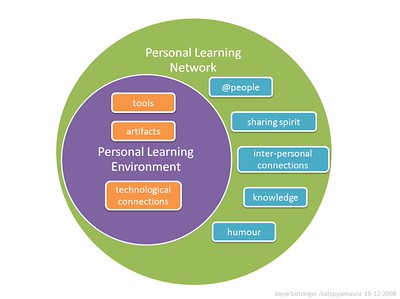
Early in the course, students learned the difference between a Personal Learning Environment (PLE) and a Personal Learning Network (PLN).
Couros shared visuals and discussed these ideas further in his blog:
http://educationaltechnology.ca/couros/1156
The blog also documented Twitter conversations that helped participants build connections and expand their learning network.
The main distinction was that a PLN emphasizes social and human connections, while a PLE focuses more on the tools and resources an individual uses.
Couros summarized this idea by defining a PLN as:
“Personal learning networks are the sum of all social capital and connections that result in the development and facilitation of a personal learning environment.”
Strategies for Building a PLN
Immerse Yourself
Become familiar with digital tools and learn how they connect you with others.
Learn to Read Social Media
Use tools such as blog readers and search engines to discover information, monitor discussions, and follow meaningful conversations.
Strengthen Your PLN
Encourage interaction by providing feedback and engaging with others’ work. Learning networks grow stronger when participants actively support one another.
Know Your Connections
When instructors understand students’ strengths and areas for growth, they can connect learners who can support each other’s development.
Couros knew the course had been successful when students continued participating in their learning networks long after the course had finished. One student reflected:
“The best part of this course is that it’s not ending. With the connections we’ve built, it never has to end.” (p. 127)
References
“What’s Real Online? Media Literacy Lesson.” Www.Medialiteracyweek.Ca, Canadian Government Digital Media Center, 15 Oct. 2021, https://www.youtube.com/watch?v=JQZfNCd-iwI. Accessed 28 July 2026.
Miller, Jesse. “Social Media and Evening News.” EDCI 338 A02 – MEDIA LITERACY LUI, 21 July 2026.
Hirst, Martin. “Chapter 4. The Political Economy of Fake News .” Navigating Social Journalism: A Handbook for Media Literacy and Citizen Journalism , 2019.
X, Ted. TEDxNorwichED Incoporating & Accounting for Social Media in Education. TEDxNorwichED, 28 Mar. 2016, https://www.youtube.com/watch?v=ZteEZbAtsNI. Accessed 28 July 2026.
Couros, Alec. “Part 2 Learning Designs for Emerging Technologies: Chapter 6 Developing Personal Learning Networks for Open and Social Learning .” Emerging Technologies in Distance Education, AU Press, Athabasca University, Edmonton, Alberta, 2010, pp. 109–128.
Trilling, Bernie, and Charles Fadel. “Digital Literacy Skills-Media Literacy.” 21st Century Skills – Learning for Life In Our Times, Jossey-Bass, San Francisco, California, 2009, p. 66.
Pandian, Ananth. “Steph Curry Is a Co-Founder of New Social Media Platform Called Slyce.” CBS Sports, 4 Mar. 2016, www.cbssports.com/nba/news/steph-curry-is-a-co-founder-of-new-social-media-platform-called-slyce/.