Assignment #1 PLN & Public Communications & Digital Identity
Digital identity is the way we interact online. This involves social channels such as Facebook and Instagram, the content we post, share, or like, and the digital tools we use in our everyday lives. This collective activity shapes how our online presence is perceived by others during interactions. For example, when someone searches to find out more about who I am, they see how I educate others through my presence. This is also how a future employer might perceive me through the lens of discovering who I am as a person and a professional.
Whatever I do online—whether creating, writing, or sharing—can be viewed as my intended impact on others and the world, especially knowing that we leave a lasting digital footprint of our learning. In his video “What is Digital Identity?” (specifically from the 0:35 mark onward), Eric Stoller refers to this as a publicly searchable portfolio of blogs or tweets. Because of this, we need to be careful and aware of how an observer may interpret our content or behavior weeks or years later. Anything a person posts can change in meaning or intent if it is taken out of context.
As individuals interested in new ideas and technology, being active on social media grants us access to being ever-evolving, lifelong learners. Addressing changing career landscapes and emerging technologies, Stoller explains in his second minute that social media will expose whether or not we possess a genuine, deeper passion for lifelong learning in these areas of interest.
Digital identities have evolved significantly over the past 20 years, saving countries money and users time. In a panel video from Davos 2019, at the 4:19 mark, a representative from Estonia shared how vital security and safety are for digital identity. In Estonia, a digital ID card links citizens to multiple networks, including healthcare, taxes, and other public services designed to make life easier. Building these nationwide systems depends heavily on the ethics and values shared between the country and its users.
Later in the video (at the 26:21 mark), researcher James Manyika brings up the importance of building trust through the secure and private handling of personal data. Following this point, a panelist from India noted that when laws are clear and well-enforced, it creates a balance; users can trust that when they encounter digital risks, those issues will be dealt with in a fair and just manner. The Estonian situation was summarized in the 29th minute, emphasizing that the key pillars for countries—and for cross-border cooperation—are secure platforms that guarantee trust, transparency, and data security when building a digital identity.
While reading chapter 6 of Professor Karl Spracklen’s book, Digital Leisure, the Internet, and Popular Culture: Communities and Identity in a Digital Age, I began connecting his theories to my own Personal Learning Network (PLN). In the concluding sections, I will explore how these ideas relate to developing a digital identity.
When applying the idea of how I use my PLN and social media to inform my identity within what Professor Spracklen calls a “leisure space,” I find myself interacting with like-minded friends primarily on Instagram and Facebook. While the most active users constantly share their likes and create content, I try to do the same. This space, in turn, becomes a place where I learn from those in my community. For example, my faith and the basketball teams I follow provide a wealth of content that shapes my worldview. Everything I learn and share has become my current digital identity: a person guided by faith with a keen interest in the NBA, particularly the Golden State Warriors.
While forming what I call my “Personal Social Learning Network,” I can relate to Professor Spracklen’s assertion that “people find a sense of belonging through social networks.” He builds on this by using the analogy of onion skin layers to represent the boundaries of community membership. Within these online “imaginary communities,” different levels of membership exist. These levels are constantly redefined and evaluated by those in our inner circle—our closest “onion layers”—as well as by peripheral followers we might not even realize are watching. In my case, I try to influence others with the cool things I discover or experience, while also absorbing the content others share with me. This interaction gives me a sense of belonging and identity. I also connect with a quote from researcher Catherine McCosker, who notes that our social media interactions often stem from a desire to be perceived as “in the know”—whether that means sharing creative or humorous content, or being the first to break updated details to our network.
The final idea to explore is how social media serves as a forum for social activism. I can again see how my own faith impacts me, driving a desire to share it in the hope that it positively influences others. This chapter highlights how political ideals (from both the right and left), religious beliefs, or even conspiracy theories shared online can heavily influence a social network. Professor Spracklen concludes that these online spaces are excellent for like-minded communities, allowing members to be shaped by what they read and view while fostering a positive, communicative space and a true sense of belonging.
The article on Personal Learning Networks (PLNs) by Rajagopal, Brinke, Bruggen, and Sloep clarified the structures, skills, and future considerations necessary to maximize one’s professional networking experience.
To begin, the authors outline a three-part structure for a PLN: building, maintaining, and activating. Building involves adding new connections who can contribute valuable resources or insights. Maintaining requires consistent outreach to keep those connections alive. Finally, activating means engaging specific people at the right time to deepen a learning experience.
The study highlights three main factors that influence this process: personal interests, relationships, and the learner’s attitude. Identifying personal interests helps learners find common ground, sustain connections, and locate experts in specific fields. Furthermore, the strongest relationships form with individuals who share a similar network, possess a trusted reputation, are easily accessible, and hold similar interests that invite future collaboration. The final factor is the participant’s learning attitude. The authors explain that when a “trigger for association” is present, participants can successfully relate their learning to others within professional contexts like conferences, seminars, or online platforms. As university students, we can apply this by building our own networks. By forming meaningful connections within our courses or faculties, we can seek out varying levels of expertise, build trust, and learn together through shared study topics.
The structure of the three-layered Professional Networking Model, shows that tackling a task with the right attitude and intention—together with the right activity—leads to successful learning outcomes. When insights are shared within a trusted group of skilled professionals who use technology effectively (such as browsing and selecting pertinent details when researching), the learning becomes truly meaningful.
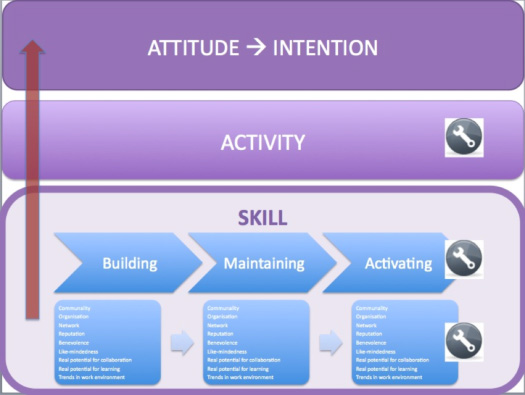
On the flip side, while a Personal Learning Network image above reverses the arrow going upward, shares these same components, it relies much more heavily on technology to function effectively—whether through email, social media, or professional platforms like LinkedIn or Facebook. The ties between these learners can develop into either strong or weak connections, and they may or may not be long-lasting. Ultimately, more research is needed to determine how effectively people learn within these tech-driven networks and how much a learner’s attitude dictates that success.
Both models highlight the potential to structure learning in productive ways. Similarly, our online summer class has the potential to greatly benefit us as learners, provided we maintain a positive attitude, build mutual trust, contribute meaningful content, and leverage technologies like blogs, emails, and social media platforms to become more collaborative learners.